
Review on Optimization of Hole-Making Operations for Injection Mould Using Non-Traditional Algorithms
Published 2016-03-30
Keywords
- Hole-making operations,
- non-traditional optimization algorithms
Copyright (c) 2023 International Journal of Industrial Engineering and Management

This work is licensed under a Creative Commons Attribution 4.0 International License.
Abstract
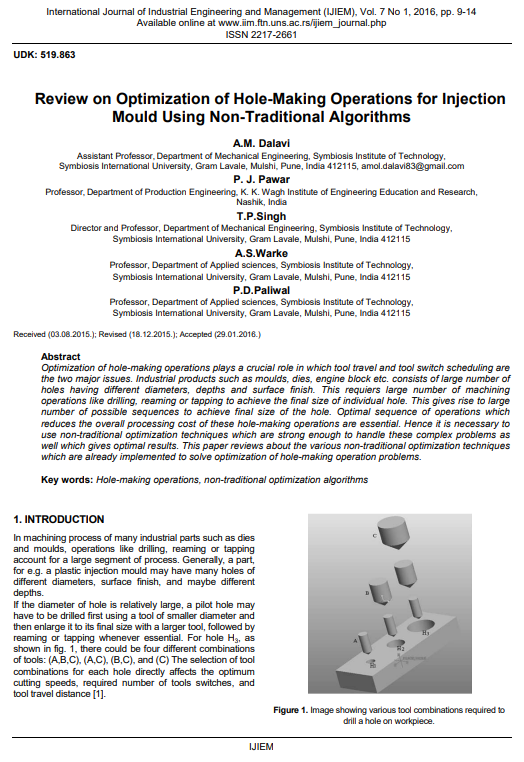
Optimization of hole-making operations plays a crucial role in which tool travel and tool switch scheduling are the two major issues. Industrial products such as moulds, dies, engine block etc. consists of large number of holes having different diameters, depths and surface finish. This requiers large number of machining operations like drilling, reaming or tapping to achieve the final size of individual hole. This gives rise to large number of possible sequences to achieve final size of the hole. Optimal sequence of operations which reduces the overall processing cost of these hole-making operations are essential. Hence it is necessary to use non-traditional optimization techniques which are strong enough to handle these complex problems as well which gives optimal results. This paper reviews about the various non-traditional optimization techniques which are already implemented to solve optimization of hole-making operation problem.
Article history: Received (03.08.2015); Revised (18.12.2015); Accepted (29.01.2016)